Wednesday, 17 October 2012

Paranormal Activity

 
When i first watch this film it didn't scare me as such it freaked me out more with a cold chill, because the film makes of this film don't realise how close this is to a true haunting in real life,this is one of the best films of it film genre in documentary style filming  to scare audiences around the world.
 
Paranormal Activity is a 2007 American supernatural horror film written and directed by Oren Peli.The film centers on a young couple, Katie and Micah, who are haunted by a supernatural presence in their home. It is presented in the style of "found footage", from cameras set up by the couple in an attempt to photograph what is haunting them.
Originally developed as an independent feature and given film festival screenings in 2007, the film was acquired by Paramount Pictures and modified, particularly with a new ending. It was given a limited U.S. release on September 25, 2009, and then a nationwide release on October 16, 2009. The film earned nearly $108 million at the U.S. box office and $194 million worldwide. Paramount/DreamWorks acquired the U.S. rights for $350,000. It is the most profitable film ever made, based on return on investment, although such figures are difficult to verify independently as this is likely to exclude marketing costs.


Plot

In September 2006, Katie (played by Katie Featherston) and her boyfriend, Micah (Micah Sloat), are a young couple who recently moved into a two-story tract house in suburban San Diego, California. Katie claims that an "evil" presence has haunted her since childhood and believes that it has followed her to their new home. Each night, Micah mounts a Sony HDR-FX1 on a tripod in their bedroom to record any paranormal activity that might occur while they sleep, in the hopes of solving the problem himself. The first night, the only thing they catch are footstep noises and the sound of keys dropping, which they find on the floor downstairs the next day. Katie hires a psychic, Dr. Fredrichs (Mark Fredrichs), who assesses that she is being haunted not by a ghost, but by a demon. He says the demon feeds off negative energy, and its intent is to haunt and torment Katie no matter where she goes. He advises them not to taunt or communicate with the demon, and to contact demonologist Dr. Johann Averies for help. Though Katie seems interested and engaged in the situation, Micah does not take it seriously.
 
The camera captures several supernatural phenomena which remain minor at first, such as a light turning on and off in the hallway during the second night, and the bedroom door moving by itself during the third night. During the fifth night however, Katie wakes up from a nightmare and it is revealed that something was whispering to her in her sleep according to the paranormal psychic. Micah begins to taunt the demon and the phenomena worsen; During the tenth night, the demon crawls through the covers and when Katie is woken up by it she hears growling in the hallway. She investigates but it runs downstairs. During the thirteenth night, they are awoken by a supernatural screech and a loud thud. They go downstairs to investigate and find the chandelier moving by itself. During the fifteenth night, Katie awakens and spends several hours standing by the bed staring at Micah while he sleeps, before going outside to sit on the backyard swing. Micah awakens by noises in the hallway and tries to convince Katie to come inside but she refuses. When Micah goes inside to get her a blanket, he finds the TV turned on in the bedroom and the kitchen sink tap on and is then startled by Katie, who followed him inside but says that he woke her up. Katie remembers nothing the next day.
 
Katie, already irritated by Micah's flippant response to the situation, becomes irate when Micah brings home a Ouija board despite Dr. Fredrichs' warnings. The two go out of the house that evening, leaving the Ouija board in the living room. The curtains and plants start to blow around and the Ouija board's planchette moves on its own. A small fire erupts on the board, but it extinguishes itself before they get home. It seems that the board has left them an unrecognizable and unreadable message. During the sixteenth night, the bed tips over. During the seventeenth night, Micah sprinkles talcum powder in the hallway and when the couple is awoken by noises, they find non-human footprints leading to the bedroom from the attic. In the attic, Micah finds a burnt photograph of a young Katie, which was previously thought to have been destroyed in an unexplained house fire.
 
The next night, a light turns on and off and the bedroom door slams shut. Loud banging is heard, as something is apparently trying to get in. They discover that the glass over a photo of them has been smashed, with Micah's image scratched. Dr. Averies is abroad when Micah finally agrees to invite him, so Dr. Fredrichs comes instead. Upon his arrival, Dr. Fredrichs immediately has a sense of dread. He apologetically leaves despite their pleas for his help, stating that his presence is only making the demon angry. During the nineteenth night, a shadow moves across the bedroom door. Katie is pulled out of the bedroom by an unknown force during the twentieth night. Stressed and exhausted, the couple decide to go to a hotel. Micah finds Katie gripping a cross so tightly that it bloodies her palm. Micah, angry at the situation, burns the cross and the picture found in the attic. Just as he is set to leave, Katie insists that they will be okay now, her voice flat, but with the hint of another voice sounding in tandem with her own.
 

The next night Katie comes out of bed and stands beside it staring at Micah for approximately two hours and then walks downstairs. After a moment of silence, Katie screams Micah's name, waking Micah who rushes to her. The camera records Katie screaming incessantly. Then Katie's screaming stops and a brief silence is followed by the sound of heavy footsteps coming up the stairs. After another brief silence, Micah's body is violently hurled at the camera, knocking it over sideways and revealing Katie standing in the doorway. She then slowly walks into the room, her clothing soaked with blood. Crouching over his body, she sniffs Micah (who has evidently been murdered) and then slowly looks up at the camera with a sly smile. As she lunges toward the camera, her face takes on a demonic appearance just as the scene cuts to black. An epilogue text states that Micah's body was discovered by the police on October 11, 2006, and that Katie's whereabouts remain unknown.
 

                        Alternate endings
In its original version, the film featured a different ending, in which Katie was seen getting killed, contrarily to her unknown fate featured in the theatrical version. In this version, after going downstairs on the final night and waking Micah with a scream, only Katie is shown returning to the bedroom, holding a large bloody kitchen knife, her shirt bloodied. She sits beside the bed, holding the knife and rocking herself, until about 2 p.m. the next day, when her friend Amber calls and leaves a message expressing her concern. At about 9:20 p.m. that night, Katie is still sitting and rocking by the bed, and Amber can be heard entering the house. During this short period, Katie stops rocking, but when Amber screams (evidently after finding Micah's body) and runs out of the house, she resumes her motion. Half an hour later, just after 9:50 p.m., police enter the home and discover Micah's body as well. As they are checking Micah for vital signs, a light turns on in the bedroom down the hallway, but before the police see it, the light turns off again. They discover Katie, still sitting beside the bed with the knife. As they call to her, she wakes from her catatonic state and seems confused. As she approaches them, knife in hand, calling Micah, they ask her to drop the weapon. Suddenly the bedroom door behind the police officers slams shut, startling them and causing them to shoot Katie, who collapses on the floor. The police then call dispatch and check the bedroom at the end of the hall, but find nothing. They discover the video camera, still running. A dedication to and a picture of Katie and Micah are then shown. The original ending for the film was available for a time for viewing on the Internet before Paramount exerted a claim of copyright on the material.
 

Once Paramount acquired the film, two new endings were developed for the film, one of them being the one seen in theaters. The scrapped ending was shown at only one public viewing and was later offered as an alternate ending on the DVD and Blu-ray releases of the film.In this ending, Katie gets out of bed and stands staring at Micah, as she did in the theatrical ending, except she does not move to Micah's side of the bed. About three hours pass, then she finally goes downstairs. She lets out a blood-curdling scream, which wakes Micah up and he runs downstairs. The screaming continues, and the sounds of a struggle are heard before the noises abruptly stop. There is silence for a short while before loud footsteps are heard on the stairs. Katie then walks into the bedroom, Micah's blood covering her shirt, with a knife in her hand. She closes and locks the bedroom door, before walking up to the camera, standing idle briefly. She then lifts the knife and slits her own throat, then falls to the floor, dead.
 
                                    Cast
 
( Beautiful ) Katie Featherston as Katie
 
Micah Sloat as Micah
 
Amber Armstrong as Amber
 
Mark Fredrichs as Dr. Fredrichs (psychic)
 
Ashley Palmer as Diane (girl on the Internet
 
Production
First-time director Oren Peli had been afraid of ghosts his entire life, even fearing the comedy film Ghostbusters, but intended to channel that fear into something positive and productive.Peli took a year to prepare his own house for shooting, going so far as to repaint the walls, add furniture, put in a carpet, and build a stairwell, in Rancho Peñasquitos. In this time, he also did extensive research into paranormal phenomena and demonology, stating, "We wanted to be as truthful as we could be." The reason for making the supernatural entity in the story a demon was a result of the research pointing to the most malevolent and violent entities being "demons". The phenomena in the film take place largely at night—the vulnerability of being asleep, Peli reasoned, taps into a human being's most primal fear, stating, "If something is lurking in your home there's not much you can do about it."
 
Attempting to focus on believability rather than action and gore, Peli chose to shoot the picture with a home video camera. In deciding on a more raw and stationary format (the camera was almost always sitting on a tripod or something else) and eliminating the need for a camera crew, a "higher degree of plausibility" was created for the audience as they were "more invested in the story and the characters".Peli says that the dialogue was "natural" because there was no real script. Instead, the actors were given outlines of the story and situations to improvise, a technique known as "retroscripting" used in the making of The Blair Witch Project. In casting the movie, Peli auditioned "a few hundred people" before finally meeting Katie Featherston and Micah Sloat. He originally auditioned them individually and later called them back to audition together. Peli was impressed with the chemistry between the actors, saying, "If you saw the [audition] footage, you would've thought they had known each other for years.During a guest appearance on The Jay Leno Show on November 3, 2009, Sloat and Featherston explained they each saw the casting call on LACasting. Featherston noted they were originally paid $500 for their work.
 
The film was shot out of sequence due to Peli's self-imposed seven day shooting schedule, though Peli would have preferred the story unfold for the actors as he had envisioned it. Sloat, who controlled the camera for a good deal of the film, was a former cameraman at his university's TV station. "It was a very intense week", Peli recalled, stating that the film would be shot day and night, edited at the same time, and would have the visual effects applied to it as the acting footage was being finalized.
The film was screened at 2007's Screamfest Horror Film Festival, where it impressed an assistant at the Creative Artists Agency, Kirill Baru, so much that CAA signed on to represent Peli. Attempting to find a distributor for the film and/or directing work for Peli, the agency sent out DVDs of the movie to as many people in the industry as they could, and it was eventually seen by Miramax Films Senior Executive Jason Blum, who thought it had potential. He worked with Peli to re-edit the film and submitted it to the Sundance Film Festival, but it was rejected. The DVD also impressed DreamWorks executives Adam Goodman, Stacey Snider, and finally Steven Spielberg, who cut a deal with Blum and Peli.
 
DreamWorks' plan was to remake the film with a bigger budget and with Peli directing, and only to include the original version as an extra when the DVD was eventually released. "They didn't know what to do with [the original]", said Blum; they just wanted to be "in business" with Peli. Blum and Peli agreed, but stipulated a test screening of the original film before going ahead with the remake, believing it would be well received by a theatrical audience.
 
During the screening, people began walking out; Goodman thought the film was bombing, until he learned that the viewers were actually leaving because they were so frightened. He then realized a remake was unwise. Paramount Pictures, which acquired DreamWorks in 2005, bought the domestic rights to the film, and international rights to any sequels, for $350,000 USD.When the film was taken in by Paramount Pictures, several changes were made. Some scenes were cut, others added, and the original ending was scrapped, with two new endings being shot. The ending shown in theaters during the film's worldwide release is the only one of the three to feature visual effects, and it differs from the endings previously seen at the Screamfest and Burbank screenings. The theatrical release was delayed indefinitely because Paramount had put all DreamWorks productions on hold. Meanwhile, a screening for international buyers resulted in the sale of international rights in 52 countries.Only after Goodman became production chief at Paramount in June 2009 did the film finally get slated for a fall release.
                                     
                                       Release
Paranormal Activity premiered at Screamfest Film Festival in North America on October 14, 2007, was shown at the Slamdance Film Festival on January 18, 2008, and screened at the 36th Annual Telluride Film Festival on September 6, 2009.
The version with the new ending, made after Paramount acquired the film, had screenings on September 25, 2009 in 13 college towns across the United States. On his website, director Oren Peli invited internet users to "demand" where the film went next by voting on eventful.com. This was the first time a major motion picture studio used the service to virally market a film.Twelve of the 13 venues sold out. On September 28, Paramount issued a press release on Peli's website, announcing openings in 20 other markets on Friday, October 2, including large-market cities such as New York and Chicago.
 
On October 3, it was reported that a total of 33 screenings in all 20 markets sold out and that the movie had made $500,000 domestically. A day later, Paramount announced that the film would have a full limited release in 40 markets, playing at all hours (including after-midnight showings). On October 6, Paramount announced that the movie would be released nationwide if the film got 1,000,000 "demands" on eventful.com. The full limited release of the film started on Friday, October 9. On October 10 the Eventful.com counter hit over 1,000,000 requests.Paramount announced soon after that the film would get a wide domestic release on Friday, October 16 and then expand to more theaters on the 23rd. By November, it was showing in locales worldwide.
This film also had no opening or closing credits, other than the copyright info shown after the film ends.


                               Reviews

 
The film received positive critical reception upon release. Based on 184 reviews collected by Rotten Tomatoes, the film has an overall approval 'certified fresh' rating from critics of 82%. Movie critics James Berardinelli and Roger Ebert each awarded it 3.5 stars out of a maximum of 4 stars. Ebert stated in his review: "It illustrates one of my favorite points, that silence and waiting can be more entertaining than frantic fast-cutting and berserk f/x. For extended periods here, nothing at all is happening, and believe me, you won't be bored" Entertainment Weekly critic Owen Gleiberman gave Paranormal Activity an A− rating and called it "frightening...freaky and terrifying" and noted that "Paranormal Activity scrapes away 30 years of encrusted nightmare clichés", Bloody Disgusting ranked the film 16th in their list of the "Top 20 Horror Films of the Decade", with the article saying, "Peli deserves props for milking the maximum amount of tension out of the spare, modern setting—an ordinary, cookie-cutter tract home in San Diego. It doesn't sound very scary, but Peli manages to make it terrifying. If you aren’t white-knuckling your armrest at least once or twice while watching it, you probably don't have a pulse.." However, David Stratton of the Australian version of At the Movies remarked that "it was extremely unthrilling, very obvious, very cliched. We've seen it all before."


                         Box office

The film opened on September 25, 2009, to 12 theaters taking $36,146 on its opening day and $77,873 on its first weekend for an average of $6,489 per venue. It took more success when it opened to 33 theaters on October 1, 2009, doubling the box office reception, grossing $532,242 for an average of $16,129 per venue, bringing the 10-day total to $776,763.

As it expanded to 160 theaters on the October 9–11 weekend, the film grossed $2,659,296 on that Friday having a per-theater average of $16,621. It went on to gross $7,900,695, which was $800,000 more than originally estimated. Over the weekend, the film reached the week's highest per-theater average of $49,379, coming in at #4 for the weekend, behind Couples Retreat, Zombieland, and Cloudy with a Chance of Meatballs. Over the weekend of October 16, 2009, Paranormal Activity expanded to 600 more theaters, grossing $19,617,650 with $25,813 per theater average gross, and bringing the total gross to $33,171,743. On the weekend of October 23, 2009, Paranormal Activity rose to #1, beating out the expected number one box office victor Saw VI, earning $21,104,070, expanding to 1,945 theaters for an average of $10,850 per theater, compared with the $14,118,444 gross from 3,036 theaters, and $4,650 average for Saw VI. The film has grossed $107,918,810 domestically and $85,436,990 in foreign markets, with a total gross of $193,355,800.

 
Using unique social media strategy for both the first and subsequent films, Paranormal Activity was one of the first film franchises of its kind to use social media to make the connection with filmgoers.

                              Accolades
The film was nominated for "best first feature" in the Independent Spirit Awards 2009
                             Home release
Paranormal Activity was released on DVD and Blu-ray on December 29, 2009. The home release media includes an alternate ending to the theatrical version, in which Katie slits her own throat in front of the camera, then collapses to the floor. It was released in the UK on March 22, 2010 on DVD and Blu-ray with some specials. In the Netherlands the movie received a release on VHS in 2010.
 
Additionally, at the end of the film, 15 minutes worth of names were added to the DVD release as part of a special promo where the fans who "demanded" the movie were asked by email if they wanted to have their name appear as a thank you for the movie's success.

Thursday, 11 October 2012

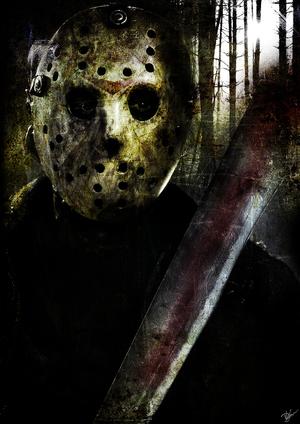
Jason Voorhees

JASON VOORHESS
Jason Voorhees is a fictional character from the Friday the 13th series. He first appeared in Friday the 13th (1980) as the young son of camp cook-turned-murderer, Mrs. Voorhees, in which he was portrayed by Ari Lehman. Created by Victor Miller, with contributions by Ron Kurz, Sean S. Cunningham, and Tom Savini, Jason was not originally intended to carry the series as the main antagonist. The character has subsequently been represented in various other media, including novels, comic books, and a cross-over film with another iconic horror film character, Freddy Krueger.
The character has primarily been an antagonist in the films, whether by stalking and killing the characters, or acting as a psychological threat to the lead character, as is the case in Friday the 13th: A New Beginning. Since Lehman's portrayal, the character has been represented by numerous actors and stuntmen, sometimes by more than one at a time; this has caused some controversy as to who should receive credit for the portrayal. Kane Hodder is the best known of the stuntmen to portray Jason Voorhees, having played the character in four consecutive films.
The character's physical appearance has gone through many transformations, with various special makeup effects artists making their mark on the character's design, including makeup artist Stan Winston. Tom Savini's initial design has been the basis for many of the later incarnations. The trademark hockey goalie mask did not appear until Friday the 13th Part III. Since Friday the 13th Part VI: Jason Lives, filmmakers have given Jason superhuman strength, regenerative powers, and near invulnerability. He has been seen as a sympathetic character, whose motivation for killing has been cited as being driven by the immoral actions of his victims and his own rage over having drowned as a child. Jason Voorhees has been featured in various humor magazines, referenced in feature films, parodied in television shows, and was the inspiration for a horror punk band. Several toy lines have been released based on various versions of the character from the Friday the 13th films. Jason Voorhees's hockey mask is a widely recognized image in popular culture
 
Appearances
 
Jason Voorhees first appears during a nightmare of the main character Alice (Adrienne King) in the original Friday the 13th film; he becomes the main antagonist of the series in its sequels. As well as the films, there have been books and comics that have either expanded the universe of Jason, or been based on a minor aspect of him.
 
 
Films
 
Jason made his first cinematic appearance in the original Friday the 13th on May 9, 1980. Jason is not a killer in this film, but is seen in the memories of his mother, Mrs. Voorhees (Betsy Palmer), and as a hallucination of the film's protagonist, Alice. Though the character is never truly seen, he propels the film's plot—Mrs. Voorhees, the cook at Camp Crystal Lake, seeks revenge for his death, which she blames on the camp counselors. Jason's second appearance was in the sequel, Friday the 13th Part 2 (1981). Revealed to be alive, an adult Jason exacts revenge on Alice for decapitating his mother in the original film. Jason (Steve Daskewisz) returns to Crystal Lake, living there as a hermit and guarding it from all intruders. Five years later a group of teenagers arrive to set up a new camp, only to be murdered one by one by Jason, who wears a bag over his head to hide his face. Ginny (Amy Steel), the lone survivor, finds a cabin in the woods with a shrine built around the severed head of Mrs. Voorhees, and surrounded by mutilated corpses. Ginny fights back and slams a machete through Jason's shoulder. Jason is left for dead as Ginny is taken away in an ambulance. In Friday the 13th Part III (1982), Jason (Richard Brooker) escapes to a nearby lake resort, Higgins Haven, to rest from his wounds. At the same time, Chris Higgins (Dana Kimmell) returns to the property with some friends. An unmasked and reclusive Jason kills anyone who wanders into the barn where he is hiding. Taking a hockey mask from a victim to hide his face, he leaves the barn to kill the rest of the group. Chris fends off Jason by slamming an axe into his head, but the night's events drive her into hysteria as the police take her away.


Friday the 13th: The Final Chapter (1984) continues the story, with a presumed-dead Jason (Ted White) found by the police and taken to the morgue. Jason awakens at the morgue and kills an attendant and a nurse, and makes his way back to Crystal Lake. A group of friends renting a house there fall victim to Jason's rampage. Jason then seeks out Trish (Kimberly Beck) and Tommy Jarvis (Corey Feldman) next door. While Trish distracts Jason, Tommy evidently kills him with his own machete. Jason's appearance in Friday the 13th: A New Beginning (1985) was short-lived. Tommy Jarvis (John Shepherd) was committed to a mental hospital after the events of The Final Chapter, and has grown up constantly afraid that Jason (Tom Morga) will return. Jason's body was supposedly cremated after Tommy killed him. Roy Burns (Dick Wieand) uses Jason's persona to become a copycat killer at the halfway home to which Tommy was moved. Jason appears in the film only through Tommy's dreams and hallucinations. In Friday the 13th Part VI: Jason Lives (1986), Tommy (Thom Mathews), released from a mental institution, visits Jason's grave and learns that Jason's body was never actually cremated, but buried in a cemetery near Crystal Lake. While attempting to destroy his body, Tommy inadvertently resurrects Jason (C. J. Graham) via a piece of cemetery fence that acts as a lightning rod. Now possessing superhuman abilities, Jason returns to Crystal Lake, now renamed Forest Green, and begins his killing spree anew. Tommy eventually lures Jason back to the lake where he supposedly drowned as a child and chains him to a boulder on the lake floor, leaving him for dead.


Friday the 13th Part VII: The New Blood (1988) begins an undisclosed amount of time after Jason Lives. Jason (Kane Hodder) is freed from his chains by the telekinetic Tina Shepard (Lar Park Lincoln), who was attempting to resurrect her father. Jason begins killing those who occupy Crystal Lake, and after a battle with Tina, is dragged back to the bottom of the lake by an apparition of Tina's father.Friday the 13th Part VIII: Jason Takes Manhattan (1989) sees Jason return from the grave, brought back to life via an underwater electrical cable. He follows a group of students on their senior class trip to Manhattan, boarding the Lazarus to wreak havoc. Upon reaching Manhattan, Jason kills all the survivors but Rennie (Jensen Daggett) and Sean (Scott Reeves); he chases them into the sewers, where he is transformed into a child by toxic waste. Jason Goes to Hell: The Final Friday (1993) marked the second time Jason was officially killed according to studio canon. Through an unexplained resurrection, he returns to Crystal Lake, where he is hunted by the FBI. The FBI sets up a sting to kill Jason, which proves successful. Through mystical possession, however, Jason survives by passing his demon-infested heart from one being to the next. Though Jason does not physically appear throughout most of the film, it is learned he has a half-sister and a niece, and that he needs them to retrieve and reinhabit his body. After resurrecting it, Jason is stabbed by his niece Jessica Kimble (Kari Keegan) and dragged into Hell.


Jason X (2002) marked Kane Hodder's last performance as Jason. The film starts off in 2010; Jason has returned after an unexplained resurrection. Captured by the U.S. government in 2008, Jason is being experimented upon in a research facility, where it has been determined that he has regenerative capabilities and that cryonic suspension is the only possible solution to stop him, since numerous attempts to execute him have proved unsuccessful. Jason escapes, killing all but one of his captors, and slices through the cryo-chamber, spilling cryonics fluid into the room, freezing himself and the only other survivor, Rowan (Lexa Doig). A team of students 445 years later discover Jason's body. On the team's spacecraft, Jason thaws from his cryonic suspension and begins killing the crew. Along the way, he is enhanced by a regenerative nanotechnology process, which gives him an impenetrable metal body. Finally, he is ejected into space and falls to the planet Earth 2, burning in the atmosphere. Set before the events of Jason X, Freddy vs. Jason (2003) is a crossover film in which Jason battles A Nightmare on Elm Street's villain Freddy Krueger (Robert Englund), a supernatural killer who murders people in their dreams. Krueger has grown weak, as people in his home town of Springwood have suppressed their fear of him. Freddy, who is impersonating Jason's mother (Paula Shaw), resurrects Jason (Ken Kirzinger) from Hell and sends him to Springwood to cause panic and fear. Jason accomplishes this, but refuses to stop killing. A battle ensues in both the dream world and Crystal Lake. The identity of the winner is left ambiguous, as Jason surfaces from the lake holding Freddy's severed head, which winks and laughs.


In the 2009 Friday the 13th reboot, young Jason (Caleb Guss) witnesses his mother's (Nana Visitor) beheading as a child and follows in her footsteps, killing anyone who comes to Crystal Lake. The adult Jason (Derek Mears) kidnaps Whitney Miller (Amanda Righetti), a girl who looks like his mother, and holds her prisoner in his underground tunnels. Months later, Whitney's brother Clay (Jared Padalecki) comes to Crystal Lake and rescues her. Eventually, Whitney uses Jason's devotion to his mother against him, stabbing him with his own machete while he is distracted when she appears

                            Literature
Jason first appeared outside of film in the 1982 novelization of Friday the 13th Part 3 by Michael Avallone. Avallone chose to use an alternate ending, which was filmed for Part 3 but never used, as the ending for his 1982 adaptation. In the alternate film ending, Chris, who is in the canoe, hears Rick's voice and immediately rushes back to the house. When she opens the door, Jason is standing there with a machete, and he decapitates her. Jason next appears in print in the 1986 novelization of Jason Lives by Simon Hawke,who also adapted the first three films in 1987 and 1988.Jason Lives specifically introduced Elias Voorhees, Jason's father, a character that was slated to appear in the film but was cut by the studio. In the novel, instead of being cremated, Elias has Jason buried after his death

 
Jason made his comic book debut in the 1993 adaptation of Jason Goes to Hell, written by Andy Mangels. The three-issue series was a condensed version of the film, with a few added scenes that were never shot.Jason made his first appearance outside of the direct adaptations in Satan's Six No. 4, published in 1993, which is a continuation of the events of Jason Goes to Hell.In 1995, Nancy A. Collins wrote a three-issue, non-canonical miniseries involving a crossover between Jason and Leatherface. The story involves Jason stowing away aboard a train, after being released from Crystal Lake when the area is drained due to heavy toxic waste dumping. Jason meets Leatherface, who adopts him into his family after the two become friends. Eventually they turn on each other. In 1994 four young adult novels were released under the title of Friday the 13th. They did not feature Jason explicitly, but revolve around people becoming possessed by Jason when they put on his mask.
In 2003 and 2005, Black Flame published novelizations of Freddy vs. Jason and Jason X respectively. In 2005 they began publishing a new series of novels; one set was published under the Jason X title, while the second set utilized the Friday the 13th title. The Jason X series consisted of four sequels to the novelization of the film. Jason X: The Experiment was the first published. In this novel, Jason is being used by the government, who are trying to use his indestructibility to create their own army of "super soldiers".Planet of the Beast follows the efforts of Dr. Bardox and his crew as they try to clone the body of a comatose Jason, and shows their efforts to stay alive when Jason wakes from his coma.Death Moon revolves around Jason crash-landing at Moon Camp Americana. Jason is discovered below a prison site and unknowingly awakened in To The Third Power. Jason has a son in this book, conceived through a form of artificial insemination.

 
On May 13, 2005, Avatar Press began releasing new Friday the 13th comics. The first, titled Friday the 13th, was written by Brian Pulido and illustrated by Mike Wolfer and Greg Waller. The story takes place after the events of Freddy vs. Jason, where siblings Miles and Laura Upland have inherited Camp Crystal Lake. Knowing that Jason caused the recent destruction, Laura, unknown to her brother, sets out to kill Jason using a paramilitary group, so that she and her brother can sell the property. A three-issue miniseries titled Friday the 13th: Bloodbath was released in September 2005. Written by Brian Pulido and illustrated by Mike Wolfer and Andrew Dalhouse, the story involves a group of teenagers who come from Camp Tomorrow, a camp that sits on Crystal Lake, for work and a "party-filled weekend". The teenagers discover they share common family backgrounds, and soon awaken Jason, who hunts them. Brian Pulido returned for a third time in October 2005 to write Jason X. Picking up after the events of the Jason X film, Über-Jason is now on Earth II where a biological engineer, Kristen, attempts to subdue Jason, in hopes that she can use his regenerative tissue to save her own life and the lives of those she loves. In February 2006 Avatar published Friday the 13th: Jason vs. Jason X. Written and illustrated by Mike Wolfer, the story takes place after the events of the film Jason X. A salvage team discovers the spaceship Grendel and awakens a regenerated Jason Voorhees. The "original" Jason and Über-Jason are drawn to each other, resulting in a battle to the death. In June 2006 a one-shot comic entitled Friday the 13th: Fearbook was released, written by Mike Wolfer with art by Sebastian Fiumara. The comic has Jason being captured and experimented upon by the Trent Organization; Jason escapes and seeks out Violet, the survivor of Friday the 13th: Bloodbath, who is being contained by the Trent Organization in their Crystal Lake headquarters.
The Friday the 13th novella storyline was not connected to the Jason X series, and did not continue the stories set forth by the films, but furthered the character of Jason in its own way. Friday the 13th: Church of the Divine Psychopath has Jason resurrected by a religious cult. Jason is stuck in Hell, when recently executed serial killer Wayne Sanchez persuades Jason to help him return to Earth in Friday the 13th: Hell Lake.] In Hate-Kill-Repeat, two religious serial killers attempt to find Jason at Crystal Lake, believing that the three of them share the same contempt for those that break the moral code.In The Jason Strain, Jason is on an island with a group of convicts placed there by television executives running a reality game show. The character of Pamela Voorhees returns from the grave in Carnival of Maniacs. Pamela is in search of Jason, who is now part of a traveling sideshow and about to be auctioned off to the highest bidder

 
In December 2006 DC Comics imprint Wildstorm began publishing new comic books about Jason Voorhees under the Friday the 13th moniker. The first set was a six-issue miniseries involving Jason's return to Camp Crystal Lake, which is being renovated by a group of teenagers in preparation for its reopening as a tourist attraction. The series depicts various paranormal phenomena occurring at Crystal Lake. Jason's actions in this storyline are driven by the vengeful spirits of a Native American tribe wiped out on the lake by fur traders sometime in the 19th century. On July 11 and August 15, 2007, Wildstorm published a two-part special entitled Friday the 13th: Pamela's Tale. The two-issue comic book covers Pamela Voorhees' journey to Camp Crystal Lake and the story of her pregnancy with Jason as she recounts it to hitchhiker Annie, a camp counselor who was killed in the original film. Wildstorm released another two-part special, entitled Friday the 13th: How I Spent My Summer Vacation, that was released on September 12 and October 10, 2007. The comic book provides new insight into the psychology of Jason Voorhees as he befriends a boy born with a skull deformity. Wildstorm has planned a six-issue series called Freddy vs. Jason vs. Ash, starring the two killers and Ash from the Evil Dead series. In this story, Freddy uses the Necronomicon, which is in the Voorhees' basement, to escape from Jason's subconscious and "gain powers unlike anything he's had before". Freddy attempts to use Jason to retrieve the book, stating it will make him a real boy. Ash, who is working at the local S-Mart in Crystal Lake, learns of the book's existence and sets out to destroy it. Wildstorm released another two-issue miniseries on January 9 and February 13, 2008, titled Friday the 13th: Bad Land, written and illustrated by Ron Marz and Mike Huddleston respectively. The miniseries features Jason stalking a trio of teenaged hikers taking shelter from a blizzard in Camp Crystal Lake.
A sequel to Freddy vs. Jason vs. Ash, subtitled The Nightmare Warriors, was released by Wildstorm in 2009. Jason escapes from the bottom of Crystal Lake to resume his hunt for Ash, but is captured by the U.S. government. Freddy helps him escape and appoints him the general of his Deadite army, using the Necronomicon to heal his accumulated injuries and decomposition; it removes his natural deformities in the process. At the climax of the story, Jason battles his nemesis Tommy Jarvis and his great-niece Stephanie Kimble; Stephanie impales him before Tommy decapitates him with a shard of glass. Jason's soul is then absorbed by Freddy, who uses it to increase his own power.
                                   
                            Concept and creation

Tom Savini applies make-up to Ari Lehman, creating his vision of Jason Voorhees.


Initially created by Victor Miller, Jason's final design was a combined effort by Miller, Ron Kurz, and Tom Savini. The name "Jason" is a combination of "Josh" and "Ian", Miller's two sons, and "Voorhees" was inspired by a girl that Miller knew at high school whose last name was Van Voorhees. Miller felt it was a "creepy-sounding name", which was perfect for his character. Miller initially wrote Jason as a normal-looking child, but the crew behind the film decided he needed to be deformed. Victor Miller explained Jason was not meant to be a creature from the "Black Lagoon" in his script, and scripted Jason as a mentally disabled young boy; it was Savini who made Jason deformed. Ron Kurz confirmed that Miller's version of Jason was that of a normal child, but claims that it was his idea to turn Jason into a "mongoloid creature", and have him "jump out of the lake at the end of the film". Miller later agreed the ending would not have been as good if he looked like "Betsy Palmer at eight years old".Miller wrote a scene where Alice dreams she is attacked in a canoe by Jason, and then she wakes up in a hospital bed. Miller's intention was to get as close to Carrie's ending as possible. Savini believed having Jason pop out of the lake would be psychologically disturbing to the audience, and since Alice is supposed to be dreaming, the crew could get away with adding anything they wanted.
When it came time to cast the role of Jason, Ari Lehman, who had received a part in Sean Cunningham's Manny's Orphans, arrived to read for the character of Jack. Before he could get started, Cunningham walked in and offered him a different part: Jason. Without having read a single word, Cunningham just looked at Ari and said, "You're the right size, you've got it." In the original Friday the 13th, Ari Lehman is seen only in a brief flashback as the surprise ending.Subsequent actors who portrayed a young Jason include Timothy Burr Mirkovich in Jason Takes Manhattan and Spencer Stump in Freddy vs. Jason. The adult role of Jason Voorhees has been played by various actors, some not credited, others taking great pride in their parts. Due to the physical demands the adult character requires, and the lack of emotional depth depicted, many of the actors since have been stuntmen. The most well-known among them is Kane Hodder, who is cited as the best to play the role

 
Many ideas were suggested for the sequel to Friday the 13th, including making the title part of a serialized franchise, where each succeeding film would be its own story and not related to any previous film under the Friday the 13th moniker. It was Phil Scuderi, one of the producers for the original film, which suggested bringing Jason back for the sequel. The director Steve Miner felt it was the obvious direction to take the series, as he felt the audience wanted to know more about the child who attacked Alice in the lake. Miner decided to pretend as if Alice did not see the "real Jason" in her dream, and Jason had survived his drowning as a boy and had grown up. After killing Jason in The Final Chapter, it was the director Joseph Zito's intention to leave the door open for the studio to make more films with Tommy Jarvis as the main antagonist. Screenwriter Barney Cohen felt Jarvis would become a substitute for Jason, but the idea was never fully developed in A New Beginning. Director and co-screenwriter Danny Steinmann disliked the idea of Jason not being the killer, but decided to use Tommy's fear of Jason as the primary story. This idea was immediately abandoned in Jason Lives, when A New Beginning did not spark the "creative success" the studio was looking for. Executive producer Frank Mancuso, Jr. wanted to bring Jason back, and he did not care how it was achieved. In yet another alteration of the series' continuity, Tom McLoughlin chose to ignore the idea that Jason had survived his drowning, instead presenting him as always having been some sort of supernatural force.Since A New Beginning, no sequel has attempted to replace Jason as the main antagonist. Miller, who has not seen any of the sequels, took issue with all of them because they made Jason the villain. Miller believes the best part of his screenplay was that it was about a mother avenging the senseless death of her son. Miller stated, "Jason was dead from the very beginning; he was a victim, not a villain.
 
Men behind the mask
 
 
Jason Voorhees went from deceased child to full-grown man for Friday the 13th Part 2, and Warrington Gillette was hired to play the role. Gillette auditioned for the role of Paul; that role eventually went to John Furey. Under the belief that he had attended the Hollywood Stuntman's School, Gillette was offered the role of Jason Voorhees. Initially Gillette was unsure about the character, but the idea of starring in his first film grew on Gillette, and he also thought the role was amusing. It became apparent Gillette could not perform the necessary stunts, so the stunt coordinator Cliff Cudney brought in Steve Daskawisz. Daskawisz filmed all of the scenes except the opening sequence and the unmasking shot at the end; Gillette returned for the unmasking scenes. Gillette received credit for playing Jason, while Daskawisz was given credit as the stunt double. When Part 3 was released the following year, Daskawisz was credited as Jason for the reused footage from the climax of the film. Initially, Daskawisz was asked to return to the role for Part 3, but it would have required him to pay for his own transportation and housing during filming. Having secured a part on Guiding Light, Daskawisz declined.
Now wanting a "bigger and stronger-looking" Jason, one that was also "more athletic and powerful", Steve Miner hired former British trapeze artist Richard Brooker. After a simple conversation, Miner decided he was the right person for the job. Being new to the country, Brooker believed that "playing a psychopathic killer" was the best way into the movie business. Brooker became the first actor to wear Jason's now-signature hockey mask. According to Brooker, "It felt great with the mask on. It just felt like I really was Jason because I didn't have anything to wear before that." For The Final Chapter, Joseph Zito brought his own spin to the character, one that required a "real hardcore stuntman"; Ted White was hired to perform the role. White, who only took the job for the money, did "get into the Jason psychology" when he arrived on the set. White went so far as to not speak to any of the other actors for long stretches.As filming continued, White's experience was not pleasant, and in one instance, he went to battle for co-star Judie Aronson, who played Samantha, when the director kept her naked in the lake for extended periods of time. Displeased with his experience from filming, White had his name removed from the credits.As with Friday the 13th Part 2, there was confusion over who performed the role in A New Beginning, partly due to the fact that Jason is not the literal antagonist in the film. When Ted White turned down the opportunity to return, Dick Wieand was cast.Wieand is credited as Roy Burns, the film's actual murderer, but it was stuntman Tom Morga who performed in the few flashes of Jason, as well as portraying Roy in almost all of the masked scenes. Wieand has been outspoken about his lack of enthusiasm over his role in the film. Feeling alienated during the shoot, Wieand spent most of his time in his trailer. By comparison, Morga enjoyed his time as Jason and made sure he "really got into the character.

 
A nightclub manager in Glendale, C. J. Graham, was interviewed for the role of Jason in Jason Lives, but was initially passed over because he had no experience as a stuntman.Dan Bradley was hired, but Paramount executives felt Bradley did not have the right physique to play the role, and Graham was hired to replace him. Although Bradley was replaced early during filming, he can be seen in the paintball sequence of the film.Graham opted to perform most of his own stunts, including the scene where Jason catches on fire while battling Tommy in the lake. The rest of the cast spoke highly of Graham, remarking that he never complained during all the uncomfortable situations he was placed in. Graham had no intention of being an actor or a stuntman, but the idea of playing the "bad guy", and the opportunity to wear the prosthetics, intrigued him. Graham was not brought back to reprise the role, but has often been cited as speaking highly of his time in the part.
Kane Hodder took over the role in The New Blood, and played Jason in the next four films. He previously worked alongside director John Carl Buechler on a film called Prison. Based on his experience working with Hodder, Buechler petitioned Frank Mancuso Jr. to hire him, but Mancuso was apprehensive about Hodder's limited size. Knowing he planned to use full body prosthetics, Buechler scheduled a test screening, the first in Friday the 13th history for the character, and Mancuso immediately gave Hodder approval upon seeing him. It is Buechler's contention that Hodder gave Jason his first true personality, based on the emotions, specifically the rage, that Hodder would emit while acting the part.According to Hodder, he wanted to "get in touch with Jason's thirst for revenge" and try to better understand his motivation to kill.After viewing the previous films, Hodder decided that he would approach Jason as a more "quick and agile" individual than he had been portrayed in the previous sequels. John Carl Buechler felt that Kane had "natural affinity for the role"—so much that Kane's appearance, when wearing the mask, would often terrify the cast, the crew, and in one incident a lone stranger that he came across on his walk back to his trailer. Initially Frank Mancuso Jr. and Barbara Sachs planned to use a Canadian stuntperson for Jason Takes Manhattan. Hodder acted as his own voice, calling and requesting that he be allowed to reprise the role; the ultimate decision was left to director Rob Hedden, who intended to use Hodder, because he felt Hodder knew the lore of the series.With Sean Cunningham's return as producer for Jason Goes to Hell, Hodder felt his chances of reprising the role were even better: Hodder had worked as Cunningham's stunt coordinator for years.Regardless, Adam Marcus, the director for Jason Goes to Hell, always intended to hire Hodder for the role.Jason X would mark Hodder's last performance as Jason, to date. Todd Farmer, who wrote the screenplay for Jason X, knew Hodder would play Jason from the beginning. Jim Isaac was a fan of Hodder's work on the previous films, so hiring him was an easy decision.
New Line believed Freddy vs. Jason needed a fresh start, and choose a new actor for Jason. Cunningham disagreed with their decision, believing Hodder was the best choice for the role. Hodder did receive the script for Freddy vs. Jason, and had a meeting with director Ronny Yu and New Line executives, but Matthew Barry and Yu felt the role should be recast to fit Yu's image of Jason.According to Hodder, New Line failed to provide him with a reason for the recasting, but Yu has explained he wanted a slower, more deliberate Jason, and less of the aggressive movements that Hodder had used in the previous films. Yu and development executive Jeff Katz recognized the outcry among fans over the replacement of Hodder as Jason, but stood by their choice in recasting.
The role eventually went to Ken Kirzinger, a Canadian stuntperson who worked on Jason Takes Manhattan. There are conflicting reports over the reason Kirzinger was cast. According to Yu, Kirzinger was hired because he was taller than Robert Englund, the actor who portrays Freddy Krueger. Kirzinger stands 6 feet 5 inches (1.96 m), compared to the 6 feet 3 inches (1.91 m) of Kane Hodder, and Yu wanted a much larger actor to tower over the 5-foot-10-inch (1.78 m) Englund. Kirzinger believes his experience on Part VIII helped him land the part, as Kirzinger doubled for Hodder on two scenes for the film, but also believes he was simply sized up and handed the job. Although he was hired by the creative crew, New Line did not officially cast Kirzinger until first seeing him on film. Kirzinger's first scene was Jason walking down Elm Street. New Line wanted a specific movement in Jason's walk; Kirzinger met their expectations and signed a contract with the studio. However, concerns that test audiences were confused by the film's original ending caused the studio to reshoot the final scene. Actor Douglas Tait was brought in to film the new ending, as he was available for the reshoot and had been the production's second choice to portray the role of Jason during the original casting.
Stuntman Derek Mears was hired to portray Jason Voorhees at the recommendation of makeup special effects supervisor Scott Stoddard. Mears's pleasant demeanor had the studio worried about his ability to portray such a menacing character on screen, but Mears assured them he would be able to perform the role. When Mears auditioned for the role he was asked why they should hire an actor over just another guy in a mask. As Mears explained, portraying Jason is similar to Greek mask work, where the mask and the actor are two separate entities, and, based on the scene, there will be various combinations of mask and actor in the performance.
                             
                              Design

Jason's original mask was molded from a Detroit Red Wings goalie mask, and would become a staple for the character for the rest of the series.


The physical design of Jason Voorhees has gone through changes, some subtle and some radical. For Friday the 13th, the task of coming up with Jason's appearance was the responsibility of Tom Savini, whose design for Jason was inspired by someone Savini knew as a child whose eyes and ears did not line up straight.The original design called for Jason to have hair, but Savini and his crew opted to make him bald, so he would look like a "hydrocephalic, mongoloid pinhead", with a dome-shaped head. Savini created a plaster mold of Ari Lehman's head and used that to create prosthetics for his face. Lehman personally placed mud—from the bottom of the lake—all over his body to make himself appear "really slimy."
For Part 2, Steve Miner asked Carl Fullerton, the make-up effects supervisor, to stick to Savini's original design, but Fullerton only had one day to design and sculpt a new head. Fullerton drew a rough sketch of what he believed Jason should look like, and had it approved by Miner.Fullerton added long hair to the character. Gillette had to spend hours in a chair as they applied rubber forms all over his face, and had to keep one eye closed while the "droopy eye" application was in place. Gillette's eye was closed for twelve hours at a time while he was filming the final scenes of the film. False teeth created by a local dentist were used to distort Gillette's face.Much of the basic concept of Fullerton's design was eliminated for Part 3. Miner wanted to use a combination of the designs from Tom Savini and Carl Fullerton, but as work progressed the design began to lean more and more toward Savini's concept. Stan Winston was hired to create a design for Jason's head, but the eyes were level and Doug White, the make-up artist for Part 3, needed a droopy right eye. White did keep Winston's design for the back of the head, because the crew did not have the time to design an entirely new head for Jason. The process of creating Jason's look was hard work for White, who had to constantly make alterations to Richard Brooker's face, even up to the last day of filming


Original concept drawings for "Über-Jason", by makeup effects supervisor Stephan Dupuis, took months to plan. Dupuis sculpted a small-scale version of the new design to show off to the filmmakers, before finally taking mold castings of Kane Hodder


Stephen Dupuis was given the task of redesigning Jason for the tenth Friday the 13th film. One concept brought into the film was Jason's regenerative abilities. Dupuis gave the character more hair and more of a natural flesh appearance to illustrate the constant regeneration the character goes through; Dupuis wanted a more "gothic" design for Jason, so he added chains and shackles, and made the hockey mask more angular. Jim Isaac and the rest of his crew wanted to create an entirely new Jason at some point in the film. The idea was for the teens to completely destroy Jason's body, allowing the futuristic technology to bring him back to life. What was referred to as Über-Jason was designed to have chunks of metal growing from his body, bonded by tendrils that grew into the metal, all pushing through a leather suit. The metal was created from VacuForm, the same material used to increase the size of the original hockey mask, and was attached by Velcro. The tendrils were made from silicone. All of the pieces were crafted onto one suit, including an entire head piece, which Hodder wore. The make-up effects team added zippers along the side of the suit, which allowed Hodder to enter and exit the suit within 15 minutes.
By the time Freddy vs. Jason entered production there had been ten previous Friday the 13th films. Make-up effects artist Terezakis wanted to put his own mark on Jason's look—he wanted Jason to be less rotted and decomposed and more defined, so that the audience would see a new Jason, but still recognized the face. Terezakis tried to keep continuity with the previous films, but recognized that had he followed them too literally, then "Jason would have been reduced to a pile of goo." Ronny Yu wanted everything surrounding the hockey mask to act as a frame, making the mask the focal point of each shot. To achieve this, Terezakis created a "pooled-blood look" for the character by painting the skin black, based on the idea the blood had pooled in the back of his head because he had been lying on his back for a long time. As with other make-up artists before him, Terezakis followed Savini's original skull design, and aged it appropriately.
For the 2009 version of Friday the 13th, effects artist Scott Stoddard took inspiration from Carl Fullerton's design in Friday the 13th Part 2 and Tom Savini's work in Friday the 13th: The Final Chapter. Stoddard wanted to make sure that Jason appeared human and not like a monster. Stoddard's vision of Jason includes hair loss, skin rashes, and the traditional deformities in his face, but he attempted to craft Jason's look in a way that would allow for a more human side to be seen. Stoddard took inspiration from the third and fourth films when designing Jason's hockey mask. The make-up artist managed to acquire an original set piece, which he studied and later sculpted. Although he had a model of one of the original masks, Stoddard did not want to replicate it in its entirety. As Stoddard explains, "Because I didn't want to take something that already existed, there were things I thought were great, but there were things I wanted to change a bit. Make it custom, but keep all the fundamental designs. Especially the markings on the forehead and cheeks. Age them down a bit, break them up." In the end, Stoddard crafted six versions of the mask, each with varying degrees of wear.

 
Characteristics
In his original appearance, Jason was scripted as a mentally disabled young boy. Since Friday the 13th, Jason Voorhees has been depicted as a non-verbal, indestructible, machete-wielding mass murderer.Jason is primarily portrayed as being completely silent throughout the film series. Exceptions to this include flashbacks of Jason as a child, and a brief scene in Jason Takes Manhattan where the character cries out "Mommy, please don't let me drown!" in a child's voice before being submerged in toxic waste, and in Jason Goes To Hell where his spirit possesses other individuals. Online magazine Salon's Andrew O'Hehir describes Jason as a "silent, expressionless ... blank slate." When discussing Jason psychologically, Sean S. Cunningham said, "... he doesn't have any personality. He's like a great white shark. You can't really defeat him. All you can hope for is to survive."Since Friday the 13th Part VI: Jason Lives, Jason has been a "virtually indestructible" being. Tom McLoughlin, the film's director, felt it was silly that Jason had previously been just another guy in a mask, who would kill people left and right, but get "beaten up and knocked down by the heroine at the end." McLoughlin wanted Jason to be more of a "formidable, unstoppable monster." In resurrecting Jason from the dead, McLoughlin also gave him the weakness of being rendered helpless if trapped beneath the waters of Crystal Lake; inspired by vampire lore, McLoughlin decided that Jason had in fact drowned as a child, and that returning him to his original resting place would immobilize him.This weakness would be presented again in The New Blood, and the idea that Jason had drowned as a child was taken up by director Rob Hedden as a plot element in Jason Takes Manhattan.


Many have given suggestions as Jason's motivation for killing. Ken Kirzinger refers to Jason as a "psychotic mama's boy gone horribly awry ... Very resilient. You can't kill him, but he feels pain, just not like everyone else." Kirzinger goes on to say that Jason is a "psycho-savant", and believes his actions are based on pleasing his mother, and not anything personal. Andrew O'Hehir has stated, "Coursing hormones act, of course, as smelling salts to prudish Jason, that ever-vigilant enforcer of William Bennett-style values." Todd Farmer, writer for Jason X, wrote the scene where Jason wakes from cryonic hibernation just as two of the teenagers are having sex. Farmer liked the idea that sex acts triggered Jason back to life. Whatever his motivations, Kane Hodder believes there is a limit to what he will do. According to Hodder, Jason might violently murder any person he comes across, but when Jason Takes Manhattan called for Hodder to kick the lead character's dog, Hodder refused, stating that, while Jason has no qualms against killing humans, he is not bad enough to hurt animals. Likewise, director Tom McLoughlin chose not to have Jason harm any of the children he encounters in Jason Lives, stating that Jason would not kill a child, out of a sympathy for the plight of children generated by his own death as a child.
In an early draft of Freddy vs. Jason, it was decided that one of the villains needed a redeemable factor. Ronald D. Moore, co-writer of the first draft, explained that Jason was the easiest to make redeemable, because no one had previously ventured into the psychology surrounding the character. Moore saw the character as a "blank slate", and felt he was a character the audience could really root for. Another draft, penned by Mark Protosevich, followed Moore's idea of Jason having a redeemable quality. In the draft, Jason protects a pregnant teenager named Rachel Daniels. Protosevich explained, "It gets into this whole idea of there being two kinds of monsters. Freddy is a figure of actual pure evil and Jason is more like a figure of vengeance who punishes people he feels do not deserve to live. Ultimately, the two of them clash and Jason becomes an honorable monster." Writers Damian Shannon and Mark Swift, who wrote the final draft of the film, disagreed about making Jason a hero, although they drew comparisons between the fact that Freddy was a victimizer and Jason was a victim. They stated, "We did not want to make Jason any less scary. He's still a brutal killer ... We never wanted to put them in a situation where Jason is a hero ... They're both villains to be equally feared." Brenna O'Brien, co-founder of Fridaythe13thfilms.com, saw the character as having sympathetic qualities. She stated, "[Jason] was a deformed child who almost drowned and then spent the rest of his childhood growing up alone in the woods. He saw his mother get murdered by a camp counselor in the first Friday the 13th, and so now he exacts his revenge on anyone who returns to Camp Crystal Lake. Teenage fans can identify with that sense of rejection and isolation, which you can't really get from other killers like Freddy Krueger and Michael Myers."


As Jason went through some characterization changes in the 2009 film, Derek Mears likens him more to a combination of John Rambo, Tarzan, and the Abominable Snowman from Looney Tunes. To him, this Jason is similar to Rambo because he sets up the other characters to fall into his traps. Like Rambo, he is more calculated because he feels that he has been wronged and he is fighting back; he is meant to be more sympathetic in this film. Fuller and Form contend that they did not want to make Jason too sympathetic to the audience. As Brad Fuller explains, "We do not want him to be sympathetic. Jason is not a comedic character, he is not sympathetic. He's a killing machine. Plain and simple."
California State University's Media Psychology Lab surveyed 1,166 people Americans aged from 16 to 91 on the psychological appeal of movie monsters. Many of the characteristics associated with Jason Voorhees were appealing to the participants. In the survey, Jason was considered to be an "unstoppable killing machine." Participants were impressed by the "cornucopic feats of slicing and dicing a seemingly endless number of adolescents and the occasional adult." Out of the ten monsters used in the survey—which included vampires, Freddy Krueger, Frankenstein's monster, Michael Myers, Godzilla, Chucky, Hannibal Lecter, King Kong, and the Alien—Jason scored the highest in all the categories involving killing variables. Further characteristics that appealed to the participants included Jason's "immortality, his apparent enjoyment of killing [and] his superhuman strength.


In 1988, Screamin' toys introduced the build-it yourself Jason figure


                      In popular culture
Jason Voorhees is one of the leading cultural icons of American popular culture.In 1992 Jason was awarded the MTV Lifetime Achievement Award. He was the first of only three completely fictional characters to be given the award; Godzilla (1996) and Chewbacca (1997) are the others. Jason was named No. 26 in Wizard magazine's 100 greatest villains of all time. Universal Studios theme parks, in collaboration with New Line Cinema, used the character for their Halloween Horror Nights event.
The character has been produced and marketed as merchandise over the years. In 1988 Screamin' Toys produced a model kit where owners could build their own Jason statuette. The kit required the owner to cut and paint various parts in order to assemble the figure. Six years later, Screamin' Toys issued a new model kit for Jason Goes to Hell. Both kits are now out of production. McFarlane Toys released two toy lines, one in 1998 and the other in 2002. The first was a figure of Jason from Jason Goes to Hell, and the other was of Über-Jason from Jason X. Since McFarlane's last toy line in 2002, there has been a steady production of action figures, dolls, and statuettes. These include tie-ins with the film Freddy vs. Jason (2003).
Jason has made an appearance in three video games. He first appeared in a 1985 Commodore 64 game. His next appearance was in 1989, when LJN, an American game company known for its games based on popular movies in the 1980s and early 1990s, released Friday the 13th on the Nintendo Entertainment System. The premise involved the gamer, who picks one of six camp counselors as their player, trying to save the campers from Jason, while battling various enemies throughout the game.On October 13, 2006, a Friday the 13th game was released for mobile phones. The game puts the user in the persona of Jason as he battles the undead.
The character has been referenced, or made cameo appearances, in various entertainment mediums. Outside of literature sources based on the character, Jason has been featured in a variety of magazines and comic strips. Cracked magazine has released several issues featuring parodies of Jason, and he has been featured on two of their covers. Mad magazine has featured the character in almost a dozen stories. He has appeared twice in the comic strip Mother Goose and Grimm. Inspired by his own experience, Ari Lehman founded a band called FIRSTJASON. Lehman's band is classified as horror punk, and is influenced by the sounds of the Dead Kennedys and The Misfits. The band's name pays homage to Lehman's portrayal of Jason Voorhees in the original Friday the 13th. One of the band's songs is entitled "Jason is Watching".

 
In 1986, coinciding with the release of Jason Lives, Alice Cooper released "He's Back (The Man Behind the Mask)" from his album Constrictor. The song was written to "signal Jason's big return" to the cinema, as he had been almost entirely absent in the previous film.Rapper Eminem has referenced Jason in several of his songs. The song "Criminal", from the album The Marshall Mathers LP, mentions Jason specifically, while songs "Amityville" and "Off the Wall"—the latter featured fellow rapper Redman—contain Harry Manfredini's music "ki, ki, ki ... ma, ma, ma" from the film series.Eminem sometimes wears a hockey mask during concerts.Other rap artists that have referenced Jason include Tupac Shakur, Dr. Dre, LL Cool J, and Insane Clown Posse.In 1989, Puerto Rican rapper Vico C had a song titled "Viernes 13" which featured Jason in Puerto Rico. The song was so popular in the island that Vico C wrote a second part titled "Viernes 13, Parte II".VH1 issued an advertisement for their Vogue Fashion Awards which was labeled "Friday the 20th", and featured Jason's mask created out of rhinestone.
Jason has been referenced or parodied in films and television shows. In the film Scream, directed by Freddy Krueger creator Wes Craven, actress Drew Barrymore's character is being stalked by a killer who calls her on her home phone. In order to survive, she must answer the man's trivia questions. One question is "name the killer in Friday the 13th." She incorrectly guesses Jason, who did not become the killer for the franchise until Part 2. Writer Kevin Williamson claimed his inspiration for this scene came when he asked this question in a bar while a group was playing a movie trivia quiz game. He received a free drink, because nobody got the answer right.In another Wes Craven film, Cursed, a wax sculpture of Jason, from Jason Goes to Hell, can be seen in a wax museum.


The stop motion animated television show Robot Chicken features Jason in three of its comedy sketches. In episode seventeen, "Operation: Rich in Spirit", the mystery-solving teenagers from Scooby-Doo arrive at Camp Crystal Lake to investigate the Jason Voorhees murders, and are killed off one by one. Velma is the only survivor, and in typical Scooby-Doo fashion, she rips off Jason's mask to reveal his true identity: Old Man Phillips. In episode nineteen, "That Hurts Me", Jason reappears, this time as a housemate of "Horror Movie Big Brother", alongside other famous slasher movie killers such as Michael Myers, Freddy Krueger, Leatherface, Pinhead, and Ghostface.Three years later, in episode sixty-two, Jason is shown on the days before and after a typical Friday The 13th.